Back
Back

Belgium - 1740

Freemason`s Ducat
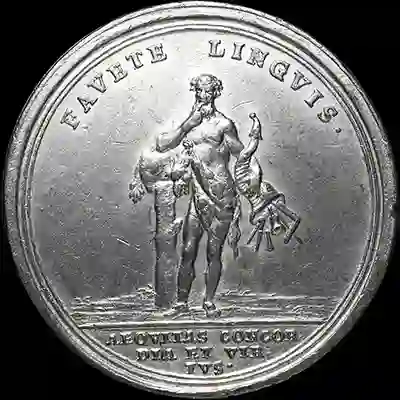
Obverse
Obverse:
Harpocrates, the god of silence, leaning on a pillar, over which is a lion's skin, covered with bees. On his left arm is a cornucopia, from which a square and other Masonic implements are falling.
Legend:
FAVETE LINGVIS. (Keep silence.)
Exergue:
ÆQVITAS CONCORDIA ET VIRTVS. (Justice, harmony and virtue.)
Size:
44.3 mm.
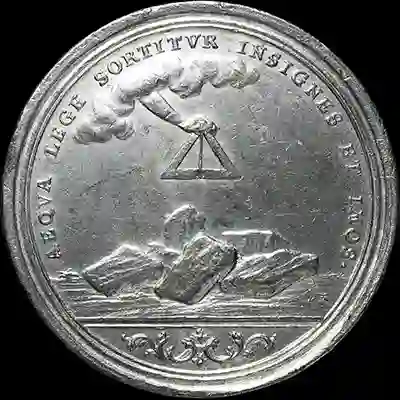
Reverse
Reverse:
A group of six rough ashlars, near one of which is a gavel ; above, a hand and arm issuing from clouds to left, suspends a level.
Legend:
ÆQVA LEGE SORTITVR INSIGNES ET IMOS. (Allotted by impartial law to the lofty and the lowly.)
Exergue:
Ornamental scroll work.

Vern's Comments:

This white metal example is much larger than the one described in Marvin, Marvin being a little more than 22.2 mm.

Marvin:

XII. Obverse, Harpocrates, the god of silence, leaning on a pillar, over which is a lion's skin, covered with bees. On his left arm is a cornucopia, from which a square and other Masonic implements are falling. Legend, FAVETE LINGVIS. (Keep silence.) In exergue, in three lines, ÆQVITAS CONCORDIA ET VIRTVS. (Justice, harmony and virtue.) Reverse, A group of six rough ashlars, near one of which is a gavel ; above, a hand and arm issuing from clouds to left, suspends a level. In exergue. Ornamental scroll work. Legend, ÆQVA LEGE SORTITVR INSIGNES ET IMOS. (Allotted by impartial law to the lofty and the lowly.) Gold, silver, and other metals. Size 14.
 
  This very ancient Medal is commonly known as the "Freemason's Ducat." There are at least four varieties, with the same devices, but varying slightly in the dies, which are mentioned by Merzdorf; the differences being in the size of the letters, of the hand, or the thickness of the cloud and in the ornamental scroll. The obverse is muled with two other reverses, which will be. described hereafter. The place of mintage of this Medal has caused considerable discussion. Merzdorf, (page II.) says most of the older catalogues mention it as having been struck at Berlin, while others attribute it to Vestner, at Brussels, in 1743; he remarks that Vestner always placed his mark upon his work, and believes its origin was at Brunswick, in the year 1745; he also states that it is mentioned in the records of the Lodge Charles of the Pillar, of Brunswick, in that year, and says that Zacharias (who has an engraving of it in IV. i) is wrong in assigning to it an earlier date. After 1772 it appears to have been struck for use as a prize.

Freemason`s Ducat

obverse

Freemason`s Ducat

Click to dismiss