Back
Back

Great Britain - 1799

Defence of Acre
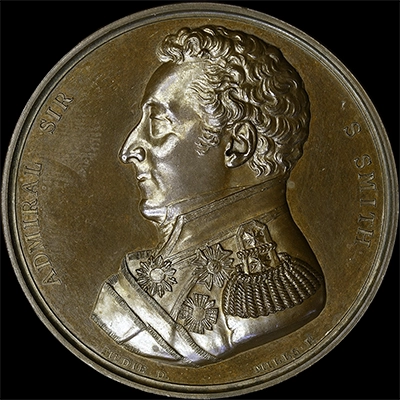
Obverse
Obverse:
Uniformed bust of Sir Sidney Smith, left.
Legend:
ADMIRAL SIR S SMITH
Size:
41 mm.
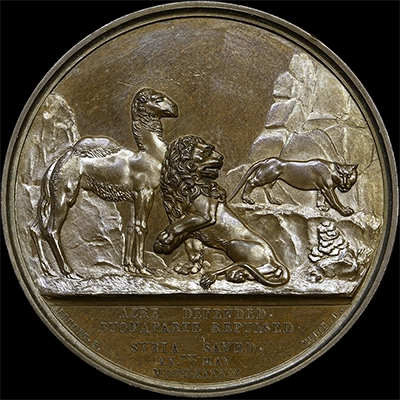
Reverse
Reverse:
The British lion protecting the Syrian camel from the French tiger.
Exergue:
ACRE DEFENDED / BONAPARTE REPULSED / SYRIA SAVED / XXTH MAY / MDCCLXXXXIX

Vern's Comments:

EIMER:
906 Siege of Acre 1799
Obv. Bust l. uniformed, ADMIRAL SIR S. SMITH
Rev. Lion, within a rocky pass, protects camel from menacing tiger. Ex. ACRE DEFENDED. BUONAPARTE REPULSED SYRIA SAVED, XXTH MAY MDCCLXXXXIX D. 41 mm. By G. Mills/N. G. A. Brenet.
BHM 476 MH 1919, 545; Mudie 7
Struck in 1820, from Mudie’s series commemorating British victories. See No. 1136.

Mudie:

No. VII.

----------------------

ADMIRAL SIR SYDNEY SMITH.

WILLIAM SIDNEY SMITH was born in the year 1764, in the parish of St. Anne's, Soho, Westminster. He was the eldest son of Captain Smith, who accompamied Lord Sackville as his aid-de-camp in the war of 1756, and who afterwards obtained a place in the royal household. He acquired the rudiments of an excellent education at Tunbridge school, under the superintendance of Dr. Knox; and in 1777 he commenced his naval career. It is a curious circumstance, that the grandfather of Sir Sidney Smith, in his will, made a solemn request to his decscendants, that "while a muscquet or a ship remained to the country, his children would never embark in trade."
    Shortly after his entering into the navy, he was placed in the Sandwich, under the command of Captain Young. He was rapidly promoted. From the Alcide of 74 guns, in which he was raised, in the year 1780, to the rank of fifth lieutenant, he was advancecl to that of commander of the Fury, a sloop of 18 guns, on the Jamaica station. Ou the 7th of May 1783 he was made a post-captain, by commission, and appointed to the Nemesis, a frigate of •' 28 guns.
    VVhen the peace took place, his ardent and enterprising character could not adapt itself to the consequent inactivity; and about the year 1788 he solicited and obtained permission to enter into the Swedish service, where he greatly distinguished himself in the war which took place between that country and Russia. The King of Sweden bestowed upon him the Grand Cross of the Swedish Order of the Sword; and, in a letter written to his late majesty George III. accompanying the honourable insignia, Gustavus thus expressed himself:- "We have returned your Majcsty what we had borrowed for our use during the late war, and what, had it been less valuable, we should have endeavoured to have retained. Captaiu Smith is an officer whom we shall long remember with gratitude."
    After this Sir Sidney was for a short time employed in the Turkish service, till he was recalled home by his Majesty's proclamation at the breaking out of the revolutionary war with France.
    He hastened from Smyrna, and joined the fleet under Lord Hood, just before the conclusion of the siege of Toulon. This was a service peculiarly calculated for the display of his extraordinary powers. He harassed the vessels and craft of the enemy by incessant attacks, which were concieved with judgment and executed with vigour. Following their squadrons into their own ports, he at last forced an entry into the bay of Herqui (March 18, 1796), destroyed the batteries of its promontory, and burned the ships in the harbour. He at this time commanded the Diamond of 38 guns, to which he had been appointed in 1794.
    The ardour and intrepidity of his conduct placed him, at last, a captive in the hands of the enemy. This disaster occurred on the 18th of April 1796. He was then stationed off Havre de Grace, where he observed one of the French lugger privateers which had been driven, by the strong setting-in of the tide, into the harbour, above the forts. He captured the privateer, but was compelled to remain in the same situation himself during the night. In the morning, the French discovered their lugger in the tow of a string of English boats. A signal of alarm was immediately given, and several gun-boats, and other armed vessels, bore down upon the English. All resistance soon became unavailing, and Sir Sidney, with not above nineteen of his gallant associates, were compelled to surrender themselves prisoners of war. He was conveyed to Paris, and sent, first, to the Abbaye, whence he was afterwards removed to the Temple. Here he was treated with great rigour, and every precaution was adopted that could prerent, as it ,ras thought, the possibility of escape. Means, however, were found to baffle the vigilance of his gaolers, and by the aid of a fabricated order for his removal to another prison, he contrived to make his escape, and arrived in London in May 1798. He was welcomed in England by the general congratulations of the people, who considered his return as little less than a miracle.
    In the month of June following Sir Sidney was appointed to the command of the Tiger of 80 guns, and in November he sailed for the Mediterranean, where he was honoured with a distinct command as an established commodore on the coast of Egypt. It was while he acted upon this station that he performed the brilliant achievement which has made his name so justly celebrated.
    Buonaparte, who commanded the French army in Egypt, having determined to march against Acre, he crossed the little river of that name on the 18th of March 1799, and encamped upon an insulated eminence that was near to, and parallel with, the sea. On the 20th the trenches were opened, at about one hundred and fifty fathoms from the fortress. Ghezzar Bashaw, who commanded this place, sent timely notice to Sir Sidney Smith of the intended advance of Buonaparte, and on the 7th of March he sailed for the coast of Syria. On the 11 th he arrived before Carissa, and on the fifteenth steered for St. John D'Acre, to concert measures with Ghezzar, having got the start of the enemy by two days, which he employed in making preparatious for defence. He had captured, in his passage, the whole French flotilla, under the command of Eydoun, laden with heavy cannon, ammunition, platforms, and other articles necessary for Buonaparte's army to undertake the siege. This artillery, consisting of 44 pieces, was immediately mounted on the ramparts of Acre against the lines aml batteries of the enemy, as well as on gun vesse1s.
    On the 30th of March the French effected a breach in the wall on the north-east part of tbe town, and endeavoured to take it by assault, but were vigorously repulsed by the garrison with considerable loss. The ditch was filled with dead bodies. The troops of Ghezzar afterwards made three successful sorties, in the last of which the English destroyed the whole construction of a mine which had been prepared by the enemy. It was judged, indeed, to be the best mode of defence, by the garrison, to make frequent sorties, in order to keep the French on the defensive, and to impede the progress of their covering works.
    Onu the 28th of April, the French were encouraged by the arrival of three pieces of battering artillery, 24 pounders, and six pieces of eighteen. The English also received reinforcements, by the timely arrival, on the 7th of May, in the bay of Acre, of a fleet of corvettes and transports under the command of Hassin Bey.
    The approach of this additional strength was the signal to Buonaparte for a most vigorous and persevering assault, in the hope of getting possession of the town before the reinforcements could disembark. The gun-boats, which were within grape distance of the head of the attacking column, added to the Turkish musquetry, did great execution; but still the enemy gaincd ground. They had made a lodgment on the second story of the north-east tower, the upper part being entirely battered down, and the ruins of the ditch forming the ascent by which they mounted. On the omring of the 8th of May the French standard floated on the outer angle of the tower. Hassan Bey's troops were in the boats, but as yet only half way on the shore. This was a most critical part of the contest; and an effort was necessary to preserve the place for a short time, till their arrival. Sir Sidney, therefore, landed the boats at the Mole, and took the crews, armed with pikes, up to the breach. The enthusiastic gratitude of the Turks, men, women, and children, at the sight of such a reinforcement at such a time can hardly be described. A fierce and sanguinary conflict now took place, which continued the whole of the day, and during which Sir Sidney displayed the most heroic courage, as well as the most consummate talents in conducting the defence of the place. A little before sunset, a massive column of the enemy appeared advancing to the breach with a solemn step. The Bashaw's idea was, not to defend the breach this time, but rather to let a certain number of the enemy in, and then close with them, according to the Turkish mode of warfare. The French column consequently mounted the breach unmolested, and descended from the rampart into the Bashaw's garden, where, in a very few moments, the bravest and most advanced among them lay headless corpses: the sabre, with the addition of the dagger in the other hand, proving more than a match for the bayonet. The rest retreated precipitately.
   The next night, the 9th of May, the Turkish Chiffiick regiment made itself master of the enemy's third parallel, by an intrepid sortie. A flag of truce was now sent into the town by the hand of an Arabian dervise, with a letter to the Bashaw, proposing a cessation of arms, for the purpose of burying the dead bodies, the stench from which had become intolerable, and threatened the existence of both armies, many having died delirious a few hours after being seized with the first symptoms of infection. While the answer was under consideration, a volley of shot and shells, on a sudden, announced an assault, which, however, the garrison was ready to receive, and the assailants only contributed to increase the dead bodies, "to the eternal disgrace," observed Sir Sidney in his dispatch, "of the general who thus disloyally sacrificed them."
   All hopes of success being now utterly at an end, the enemy had no alternative but to retreat, which he accordingly did, in the night, between the 20th and 21st of May, after a siege of sixty days! This was the first check which Buonaparte received, in his military career, from the skill and bravery of a British general and British troops. How little did he then dream that from the same source was to flow the tide that finaly overwhelmed him!

DESCRIPTION OF THE MEDAL.


OBVERSE.-Bust of Sir Sidney in his naval uniform.
REVERSE.-The memorable and most important defence of St. Jean D'Acre by this officer is represented by a Lion protecting a defenceless Camel (the symbolical representative of Syria) from the attacks of a Tiger (France).-Inscription-" ACRE DEFENDED-BUONAPARTE REPULSED-SYRIA SAVED-20TH MAY, 1799."

scan from Mudie...


BHM:

No. 476
AR, AE, WM 41 by G. Mills & N. G. A. Brenet.

AR R;AE N; WM R.
For. IV/186; M. 7; M.H. 545; S. 00/27.
AM; BM; HC; NMM.

One of Mudie's National Medals (see No. 1057) issued in 1820. Examples of this medal occur in white metal and are probably restrikes and were not included in the series. This medal is believed to have been struck in gold but no specimen has been met with. See also note to No. 473.

British Historical Medals, p. 116


Defence of Acre

obverse

Defence of Acre

Click to dismiss