Back
Back

Great Britain - 1815

Overseers of the Poor penny - (Sheffield)
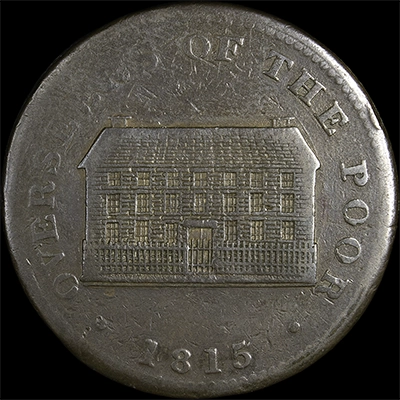
Obverse
Obverse:
View of the workhouse.
Legend:
OVERSEERS OF THE POOR
Exergue:
• 1815 •
Size:
34 mm.
Edge:
centre grained backslash
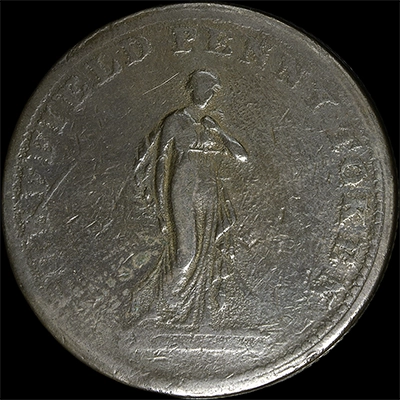
Reverse
Reverse:
Justice, standing front, on a pedestal, holding olive branch and scales.
Legend:
SHEFFIELD PENNY TOKEN

Vern's Comments:

Withers:

SHEFFIELD
Overseers of the Poor

1025 Penny, 1815.
OVERSEERS OF THE POOR • 1815 • view of the workhouse. The eaves line to the centre of S and the beginning of P The base line of the building lines to the last limb of R There are only 4 vertical bars to the gate. The 5 of the date is over a 3.
℞ SHEFFIELD PENNY TOKEN Justice, standing front, on a pedestal, holding olive branch and scales. The foot is over the D The upright of K in TOKEN lines to a bead in the border.
Davis ---
Edge : centre grained backslash D16.
34mm 22.3g Die axis ↑↓.      R

The workhouse, depicted on the token, stood in West Bar. It was opened in 1733, although curiously, according to the town burgery accounts, it seems to have been built in 1722 at cost of £346 18s 3d. It was built of brick and was enlarged in 1759. In Sheffield in the Eighteenth Century by R E Leader (published 1905), the author states that it had a frontage 'facing east, with a low-walled court before it'. At the end of this building, cross-wise, was another long building, 'with a yard on either side, and extending to a lane which separated it from the end of property standing between Westbar Green and Gregory Row'.
   It was eventually taken down in 1829, after many years of debate about its inadequacy, and the 317 paupers housed there at that time were transferred to the new workhouse at Kelham.

DISTURBANCES IN THE COUNTRY Under this heading, the Cheltenham Chronicle and Gloucestershire General Advertiser for St George's day, 1812, has the following entry:
SHEFFIELD. - About noon on Tuesday, between 40 and 50 poor men, [i.e., paupers from the workhouse] employed in preparing a piece of land for a new buying ground, marched into the potatoe market, where their number being much increased, they began to throw the potatoes in every direction, breaking windows all round the market place, and driving the farmers and others from the market. They then proceeded to break open the potatoe cellars, which were soon emptied of their contents. One part of the mob made up High-street, to Mr. Woolin's flour warehouse, where they broke a few squares of glass, but did no other damage. The greater part of the people then rushed to the Local Militia store-room, burst it open and took from six to 300 stand of arms which they broke in pieces. The military now arrived, and preserved the remainder. The volunteer cavalry were called together, and the Local Militia drums beat to arms, under a very strong guard.
The soldiers took several of the ring-leaders into custody; the shops were all shut up; the Riot Act was read three times, but all to no purpose; two post-chaises of the rioters are sent to York Castle, guarded by two field pieces. Artillerymen arrived to guard the ammunition.
Halliday engraved the dies.
It is sometimes very difficult to see the H on the pedestal. It can either fill on the die, or vanish due to wear on the token after striking. Several times Davis notes that the H is absent, when if he had examined a better specimen, he would have seen it. The Y on the right of the pedestal (D.132) would seem to have been a figment of his imagination - possibly resulting from a combination of wear and damage to the specimen he had. Many of the dies were used when rusted, filled and breaking up.

Overseers of the Poor penny - (Sheffield)

obverse

Overseers of the Poor penny - (Sheffield)

Click to dismiss