Back
Back

Great Britain - 1813

Flint Lead Company penny
Obverse
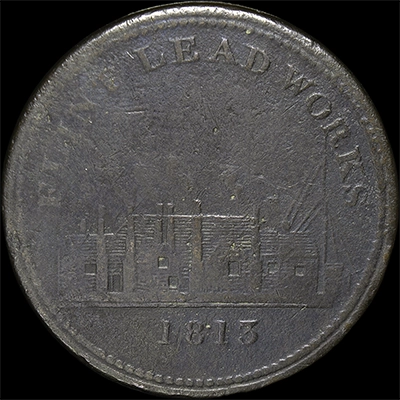
Obverse:
Factory buildings with smoking chimneys; to the right, a crane and the masts and rigging of a ship
Legend:
FLINT LEAD WORKS
Exergue:
1813
Size:
34.4 mm.
Edge:
centre grained backslash
Reverse
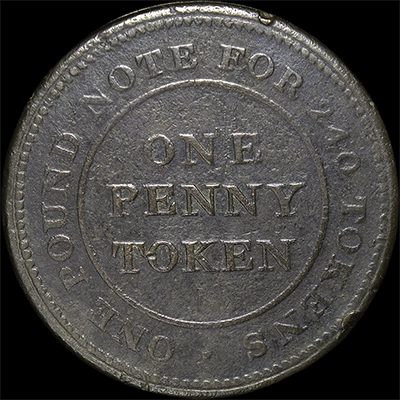
Reverse:
Within a circle, ONE PENNY TOKEN
Legend:
ONE POUND NOTE FOR 240 TOKENS ·

Vern's Comments:

This is heavily worn and Withers uses the number of chimneys as part of their variety classification. Like Davis below I had trouble counting them. I settled on 1310 because of the reverse.

Withers:


FLINT (Flintshire)
Flint Lead Works

8 chimneys (1310 - 1313)
1310 Penny, 1813.
FLINT LEAD WORKS Factory buildings with 8 chimneys; to the right, a crane and the masts and rigging of a ship; 1813 in ex. There is no smoke from the first chimney on the left. The mast points to and nearly touches the first limb of R There are 7 stays to the masts. The crane is represented by a single line.
℞ ONE POUND NOTE FOR 240 TOKENS · around; in centre, within a circle, ONE PENNY TOKEN The figure 4 is without a crosslet. The top of Y in PENNY lines to the space after 240 The top of T in TOKEN lines to the centre of O in POUND
Davis 8 (and 9)
Edge : centre grained backslash D3.
34mm 18.3g Die axis ↑↓.      C

Up to the mid-19th century, the main industries of Flint were coal mining and lead smelting. In 1800 approximately 800 people were employed in the local pits and around 150 tons per week were raised. The lead works processed around 6000 tons of ore per annum, producing not only lead, but also silver. Lead was sold on as bars, sheet and pipes.
   The company was founded by George Roskell and was the only issuer of tokens in North Wales in the 19th century. The company produced lead from ore obtained from mines on the nearby Halkyn mountain. These lead smelting works had been long established when the tokens were issued. The works passed into the hands of Roskell, Tipton and Co.; by which firm, or their successors (Roskell, Williamson and Co.), the token was issued. In 1852 the Flint Lead Works became absorbed in the more extensive Alkali Works of Muspratt Bros. and Huntley, which by 1885 was one of the largest, if not the largest, chemical works in Britain.
   The populatior of Flint in 1821 was 1,612. It is therefore unlikely that this considerable issue would have been for Flint alone. It is probable that these tokens circulated in neighbouring Chester, Liverpool and Manchester.
   Davis, working from worn specimens, was unable to count chimneys correctly. Certainly we have not been able to match the numbers of chimneys that he saw with the numbers that are apparent to us.
   Sharp et al. say that the dies were engraved by Halliday. However, from the style and the edges, it appears that 1319 and 1320 are by a different hand and not the same factory.

Flint Lead Company penny

obverse

Flint Lead Company penny

Click to dismiss