Back
Back

Great Britain - 1813

Glanclywedog Factory penny

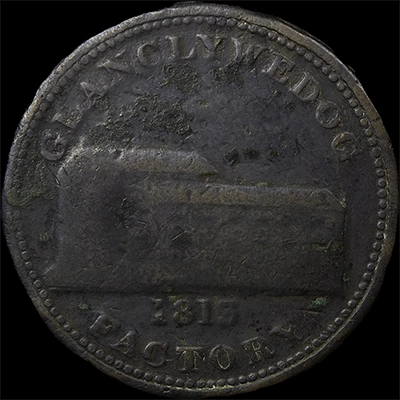
Obverse
Obverse:
View of factory buildings
Legend:
GLANCLYWEDOG
Exergue:
1813 FACTORY
Size:
34 mm.
Edge:
Milled slash
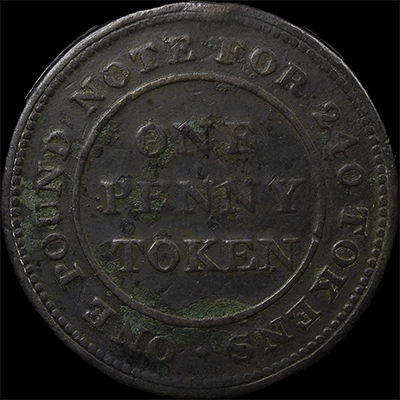
Reverse
Reverse:
In centre, in a circle ONE PENNY TOKEN
Legend:
ONE POUND NOTE FOR 240 TOKENS •
Vern's Comments:

Withers:
GLANCLYWEDOG FACTORY

1330 Penny, 1813.
GLANCLYWEDOG view of factory buildings; 1813 FACTORY below.
℞ ONE POUND NOTE FOR 240 TOKENS • around; in centre, in a circle ONE PENNY TOKEN.
Davis (Denbigshire) 1
Edge : centre grained slash E11.
34mm 18.1g Die axis ↑↓.      C

Sharp erroneously ascribed this token to Denbighshire. Davis, and later Bell, accepted his attribution.
   The Glanclywedog factory, producing flannel at the time of issue of the token, began as a fulling mill and dye works around 1790. It was owned by William Hunt and situated near Llanidloes, in Montgomeryshire, on the bank of the River Clywedog. Hunt's son-in-law, Edward Ingram, added a carding and slabbing factory driven by water power. Charles Cole, a rich Englishman, brought in money, the factory was enlarged and more machinery added. Cole eventually took control of the business and it was he who issued the token. Several owners and bankruptcies later the factory finally closed in 1915 and the building was destroyed by fire in 1935. For a full account of this enterprise see DW Dykes, 'The Glanclywedog Factory Penny' in BNJ 1965.
   Sharp et al. say that Halliday engraved the dies for this piece.

Glanclywedog Factory penny

obverse

Glanclywedog Factory penny

Click to dismiss