Back
Back

Great Britain - 1811

Bath penny
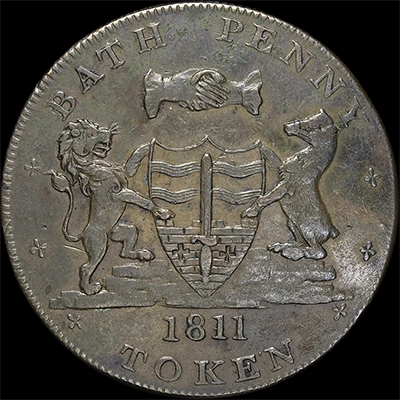
Obverse
Obverse:
City arms with supporters, clasped hands above
Legend:
+ + BATH PENNY + +
Exergue:
1811 + TOKEN + in two lines
Size:
34.5 mm.
Edge:
grained slash
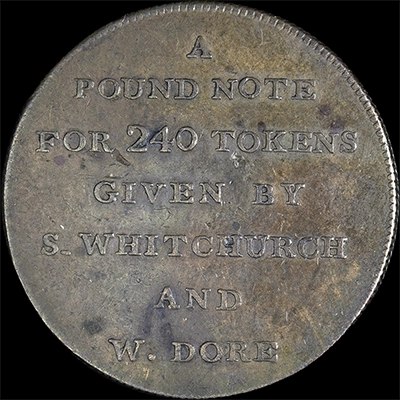
Reverse
Reverse:
In seven lines: A / POUND NOTE / FOR 240 TOKENS / GIVEN BY / S. WHITCHURCH / AND / W. DORE

Vern's Comments:

ad from Withers

Withers:

BATH (Somerset)
ST Whitchurch & W Dore

Arms and Supporters
15a Penny, 1811.
+ + BATH PENNY + + around city arms with supporters, clasped hands above; 1811 + TOKEN + in two lines in ex.
℞ A POUND NOTE FOR 240 TOKENS GIVEN BY S. WHITCHURCH AND W. DORE
Davis 74
Edge : grained slash B10.
34mm 19.0g Die axis ↑↓.      VC

In addition to the copper pieces listed below, Whitchurch, and Dore issued four-shilling silver tokens.
   Samuel T Whitchurch, born in Frome, sought adventure as a youth. After voyaging around the world, he joined the Royal Navy and saw active service on Monmouth during the war of American Independence. He was in charge of signals on Grafton under captain Collingwood. On Alert he saw action against the Dutch off Dogger Bank in 1781. In 1782 he served under Collingwood again when the French were swept from the West Indies. It was at this time that he was severely wounded, and bore the scars for the rest of his life. Returning home, he entered business as an ironmonger and brazier at No 3 Bridge Street and prospered. In 1791 he was secretary to the Royal Universal Tontine. (Tontioes, now long since outlawed because the unscrupulous took to nefarious means of improving their chances, were schemes in which men invested money, or property, which was collected by the last surviving member, or was shared by the remaining members at the end of a fixed term.) He was a strong loyalist and he became a member of the Bath Loyal Association, which was dedicated to 'preserving Liberty, Property, and the Constitution of Great Britain against Republicans and Levellers'.
   He was Secretary and accountant to the Bath Penitentiary in 1811 and also joint secretary to the Bath Sunday School Union - this organisation having James Phipps and Isaac Orchard, other issuers of silver tokens, on its committee. He was also on the committee of the Society for the Relief of Poor Married Women and a subscriber to the Bath Auxiliary Bible Society.
   Whitchurch advertised himself as Ironmonger, Smith, Brazier, Tinman and Cutler. Business was so good that in September of 1796 he moved from Bridge Street to 26 Market Place (now High Street), the centre of the busiest part of the thriving city, next to a coaching inn from which 20 coaches per day departed to destinations all over the country. Nearby was the abbey and just down the street was a major freight carrier. Opposite was the White Lion Inn, busy with the Royal mails. Nearby and facing were the city markets and the Guildhall.
   The Bath Chronicle of January 15th, 1818, belatedly records the death of Samuel Whitchurch, who died on Christmas day, 1817. His widow and sons carried on the business. By 1902 the building had become Coates Wine Vaults, and by 1935 Cater, Stoffell & Fortt (Ltd), wine & spirit merchants, family grocers & ironmongers, who occupied 25, 26 and 27 in one form or another until 1971-2, when 26 was taken by Evans (Outsizes) Ltd, Ladies outfitters, and 27 by the Golden Egg Restaurant. In 1998 there are no street numbers visible, but a new building houses a C&A department store, with other retail shops on the ground floor, some of which were closing down. It was not possible to park anywhere near.
   William Dore, of 24 Market Place, was a hatter, hosier, mercer and draper and along with Whitchurch was a subscriber to the Union Bluecoat School established at No. 24, Kingsmead Street "to educate and clothe 30 boys from 7 to 14, in the first principles of the Christian religion, without regard to Sect or Party". In 1809 he was one of the Overseers for the Parish of St Peter and St Paul.
   The tokens were well-regarded locally. An advert in the Journal of June 1st, 1812, is shown alongside. Other adverts for the Sydney Gardens with similar references to the same acceptable tokens appeared until August, 1813.
In September 1813, Dore sold his business, advertising :
Wm. Dore respectfully informs his Friends, the Public and Visitants of Bath, that he has declined his Mercery and Haberdashery Business in favour of Messrs Bourne and Austen.

He retired to Weston, near Bath, where he busied himself with educational matters and worked towards the erection of a new school at Weston.
Dore was later a partner in the Bath City Bank (1815 - 22) and later still the proprietor of the White Lion Hotel in the Market Place, Bath. In 1819 he became High Constable of Bath.
Sharp et al. give the engraver of the above token as P. Wyon.

Bath penny

obverse

Bath penny

Click to dismiss