Back
Back

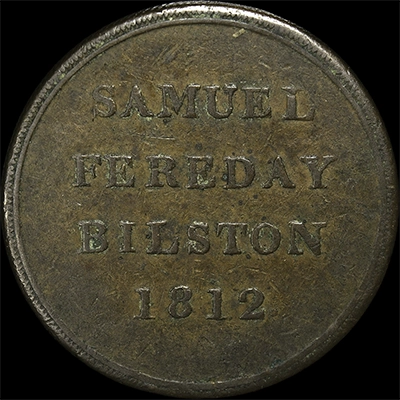
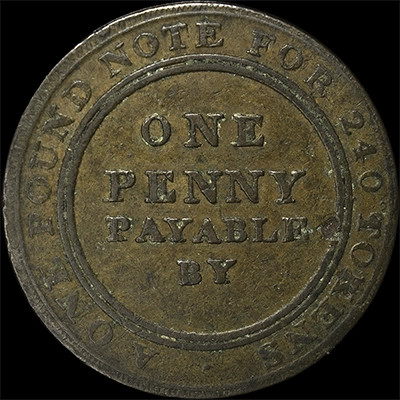
Great Britain - 1812

Fereday penny

Obverse
Obverse:
Within a double circle: ONE PENNY PAYABLE BY
Legend:
A ONE POUND NOTE FOR 240 TOKENS ·
Size:
35.5 mm.
Edge:
Neatly grained slash
Reverse
Reverse:
SAMUEL / FEREDAY / BILSTON / 1812. in 4 lines.
Vern's Comments:

Withers:


BILSTON
Samuel Fereday

LEGEND BOTH SIDES
Top of PENNY lines to the beginning of U and just before 0 (69 - 70)
69 Penny, 1812.
A ONE POUND NOTE FOR 240 TOKENS · around; in centre, within a double circle: ONE PENNY PAYABLE BY
℞ SAMUEL FEREDAY BILSTON 1812. in 4 lines.
Davis 47
Edge : neatly grained slash B10.
36mm 27.3g Die axis ↑↑.      N

illustation from Withers

Samuel Fereday was an important Black Country industrialist. Sir Edward Thomason, in his Memoirs, reckons him as the greatest ironmaster in the world, and says that he, Thomason, manufactured over two million copper tokens for him. In addition to his industrial and mining activities he was a partner in the Bilston Bank, which failed in the slump of 1816; but prior to this, due to his natural talent and through successful speculation, he rapidly acquired a considerable fortune. He lived in Ettingshall Park, a large residence, and was lavish in his hospitality. At the height of his prosperity he and his various companies employed around 5,000 workers, the largest number at that time ever to have been employed by one concern. He was keenly interested in technological advances and spent money on exploration of the coal and iron ore fields that were in the vicinity of Bilston and such things as the improvement of colliery ventilation, which was vital not only for the increase of production but the safety of workers too. His coal mines and iron works flourished due to the war against Napoleon, riding high on the boom produced by government spending, large issues of paper money, a lack of foreign competition and the need for armaments. At the end of the war, however, the economic climate changed, depression came, and by St George's day, 1817, the partnership of Fereday, Smith and Fisher was declared bankrupt.
The 1816-17 directory, under metal trades, gives his various interests and businesses as follows:
   Fereday, Bickley & Smith, Bradley Iron Works.
   Fereday & Co., Highfield Iron Works.
   Fereday & Smith, Priestfield Furnaces and Foundry.
   Fereday & Turton, Tipton Furnaces.
   Fereday, Turton & Walker, Millfield Furnaces.
Fereday was also involved in various coal-mining enterprises.
His various partnerships dissolved, or in the process of dissolving, Fereday was personally declared bankrupt on February 19th 1821 and he left for France, there he became manager of a Paris ironworks, a brave attempt at the age of 64, which was not, alas, successful. He survived in retirement until his death at Capelle, near Boulogne, in 1839.
   Thomason records that Fereday sent a carriage to Thomason's works for the tokens with which to pay his numerous work people. The first issue of his tokens depicts the Priest Field furnaces. The vaulted building with a chimney on the night is the engine house, which housed the blowing engine that provided an air blast for the blast furnaces via the reservoir visible in the centre. Above this is an inclined pathway to the charging platform, where the iron ore, limestone and coke were tipped into the furnace. Coke, still flaming from a coke oven, can be seen in the foreground. Fereday's copper tokens, with the copper and silver issues of Rushbury and Woolley, must have circulated in Wolverhampton, which, strangely, issued no tokens. Lawley's History of Bilston records:

The citizens of Wolverhampton called a meeting on the 12th december, 1811, and resolved-
"That the great influx of silver and copper coins issued by individuals, companies and corporations has become a serious public grievance, and we do hereby agree with each other to discontinue to receive them in payment from this time." It was also resolved, "That the Overseers of the Poor be requested to make application for such further supplies of three shilling and eightpence (sic*) Bank of England tokens as they may think necessary, and that all expenses of such application be defrayed by the town.
This stirred up the Bilston people who were largely convenienced by these tokens, or at least the manufacturers were, so they held a meeting and resolved- "That this town and neighbourhood, having derived great advantage from the silver and copper coins issued by Samuel Fereday, Esq., and Messrs. Rushbury and Woolley, and any attempt to impede the circulation thereof, will be impolitic and materially prejudicial to commercial intercourse in this town and neighbourhood." Very naturally after such a strong expression of opinion the meeting resolved further "That we sanction, encourage, and promote the circulation of the above-mentioned tokens."
Wolverhampton was not to be outdone, so there was an advertisement from the shopkeepers of Wolverhampton announcing their adherence to the resolution taken in public meeting, that they would neither pay nor receive such tokens, with a postscript stating that Rushbury and Woolley's silver shillings were worth only 8 pence farthing, and that Samuel Fereday's copper pennies ran two shillings and three-half-pence to the pound, the price of copper being only one shilling and a halfpenny to the pound.
*Clearly intended to read 'eighteen' rather than eight.
It must have been this hostility and criticism that caused Fereday to issue penny tokens dated 1812 that weighed 27 grams as opposed to his earlier issues which, like most other token issues, weighed only 18 grams. Certainly, there could have been little objection to the second issue, the tokens of which were as heavy as the heaviest of other issues.
   Sharp says that both issues were engraved by Halliday. Certainly some of the first are signed H, and one of the twopences unusually bears the initials TH, but then this is such an attractive design and so well executed that Halliday must have felt proud of it.
   The halfpenny tokens are a puzzle. Did they ever circulate ? They are certainly very rare. The majority of specimens that we have seen have been proof-like and the remainder well above the usual condition in which 19th-century pieces are found. Furthermore, half of them seem to have been overstruck on flans cut from the centres of the first issue of pennies. Were these part of a very small issue of halfpennies that failed to gain acceptance, or patterns for an issue that was never made ?
These pieces were manufactured by Thomason from dies engraved by Halliday.


Fereday penny

obverse

Fereday penny

Click to dismiss