Back
Back

Great Britain - 1811

Mail Coach Office halfpenny
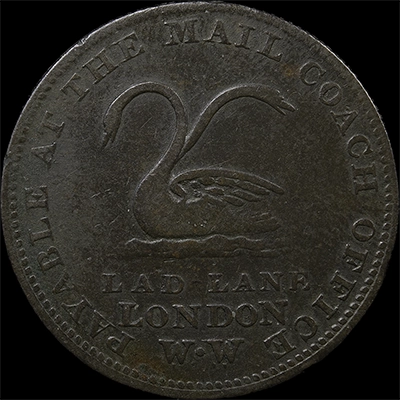
Obverse
Obverse:
A swan with two necks.
Legend:
PAYABLE AT THE MAIL COACH OFFICE
Exergue:
LAD - LANE / LONDON / W • W
Size:
28.5 mm.
Edge:
slash
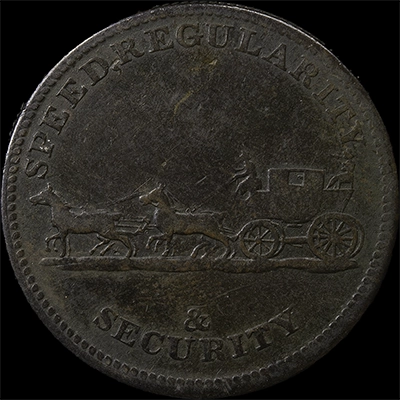
Reverse
Reverse:
A mail coach with 4 horses driving left, a crown and royal cypher monogram on the door.
Legend:
SPEED, REGULARITY & SECURITY

Vern's Comments:

Withers:
WW, Mail Coach Office
William Waterhouse at The Swan with Two Necks.


840 Halfpenny, undated.
PAYABLE AT THE MAIL COACH OFFICE around; in centre, a swan with two necks; LAD - LANE LONDON W • W in 3 lines below.
℞ SPEED, REGULARITY & SECURITY A mail coach with 4 horses driving left, a crown and royal cypher monogram on the door.
Davis (Middlesex) 64
Edge : neatly grained slash B6.
29mm 9.1g Die axis ↑↑.      VC

Davis writes
   'This was a famous posting-house. The Sun, Aug. 6, 1794, has an advertisement: "Swan with two necks, Lad Lane. BY command of their Lordships, His Majesty's Postmaster General. The Royal Mail Coach to Weymouth, &c., &c."'    He also writes, saying that he is quoting from Burn : 'The swan with two necks which was known as 'The Wonderful Bird' is a corruption of the swan with two nicks, i.e. nicks in the beak: a sign that the bird was owned by the king, whose mark was two nicks. They were so marked on the Monday following midsummer-day.'
   This is not an exact quote and contains an error not in Burn, Davis implying that birds with two nicks belong to the sovereign. This, of course, is incorrect : it is the royal birds that are unmarked. Birds with two nicks on the beak belonged to the Company of Vintners. The cruel practice of marking swans to show ownership reached a peak in elizabethan times where there were upwards of 900 distinct marks. The reason for the marking was that swans were eaten and accounted a great delicacy.
   Davis states that W Wilson was the proprietor of the tavern when the token was issued; however, an article in SCMB 1986 pp 124-5, by M Harrison, shows that this is not so and that the issuer of the token was William Waterhouse. The original contract with the Post Office was with Thomas Wilson, Innholder, of Lad Lane. However, from a timetable of 1803 it would seem that Wilson had given up and that W Waterhouse had taken over. He was still issuing tickets as Waterhouse and Son as late as September 1828 and operating mail and passenger coaches all over Great Britain. The inn was pulled down ca 1856.
scan from Withers...

It is interesting to note that travel at this time was not only slow and risky, but comparatively expensive. A contemporary advert gives the cost of travel from Exeter, via Salisbury to the Swan with Two Necks, as being 4 guineas for an inside passenger and 2 guineas as an outside passenger. The carriage of luggage cost 2½d per lb. A coach leaving the New London Inn, Exeter, at 4.45 in the morning arrived at the Swan, London, by 6 o'clock the next morning.

See also SCMB 1985 p 194 and p 325.
   Holden's Triennial Directory for 1809-11 lists 'The Swan with Two Necks, Coffee House, Tavern and Hotel. John Dewhurst'. Clearly, at that time the owner of the coaching business was not the owner of the inn.
Sharp et al. say that the dies for this token were engraved by Halliday.

Mail Coach Office halfpenny

obverse

Mail Coach Office halfpenny

Click to dismiss